RV Financing Credit Union Pre-Approval vs Dealer Finance Office
By Denise Kowalski · October 21, 2026
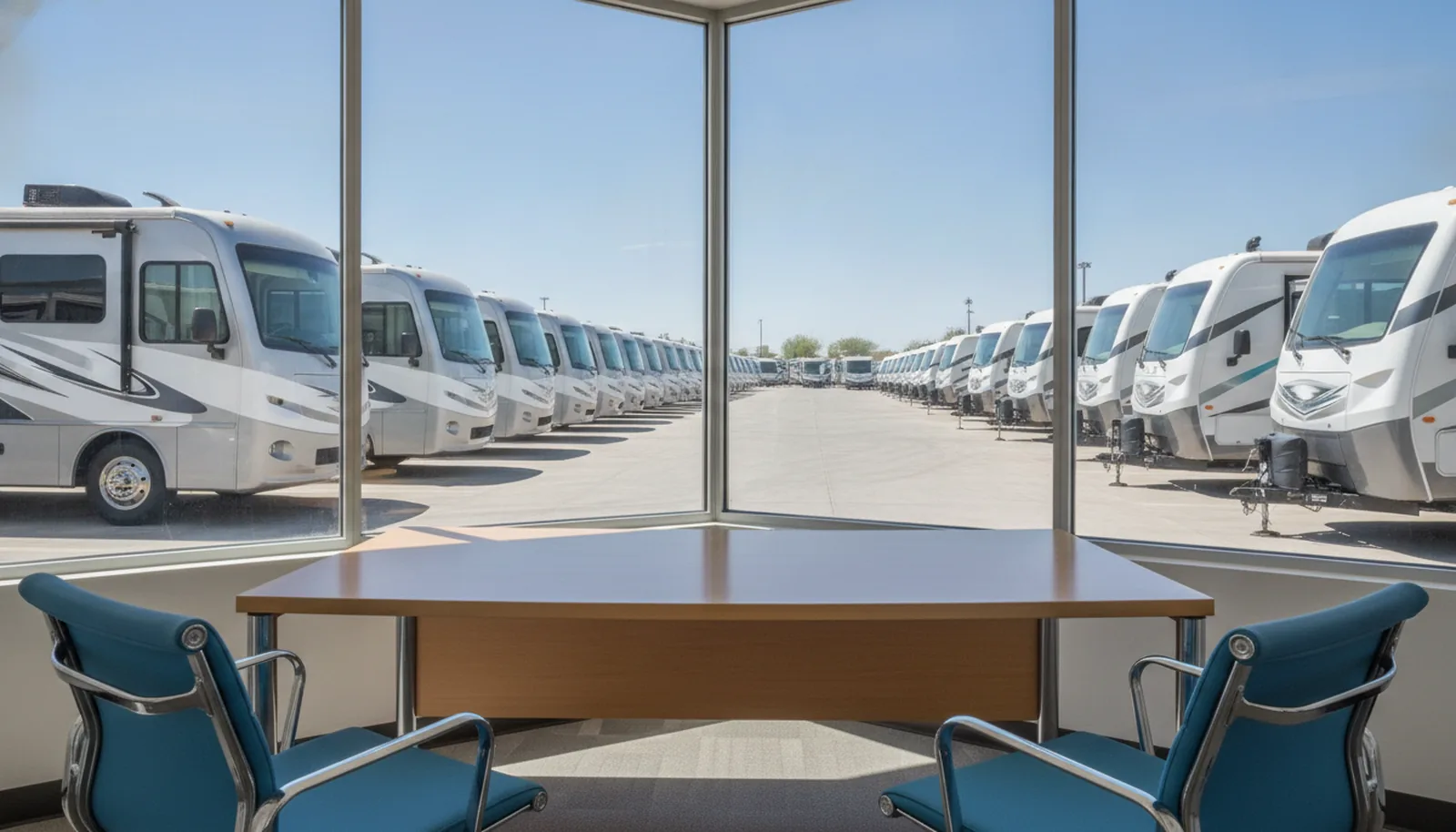
August in Mesa. 112 degrees in my carport. I’m out there washing the windshield on my 2018 Class C when a retired couple pulls into the driveway of the rental next door. They’d spent the week shopping RV dealers in Phoenix and the woman is holding a folder, and in it is their RV financing from the credit union down the road.
Inside there’s a credit union pre-approval letter. The man says, “The finance guy said his bank could beat it. Should we let him try?”
After nine years in the F&I office, my answer is yes, let him try. But keep that letter in your hand. It changes how the whole conversation goes. If your looking at RV dealers in Phoenix, a pre-approval isn’t just another piece of paper. It’s the number you measure everything else against.
How dealer-arranged RV financing actually works
The dealer can often mark up the rate the lender approves you at, within a limit the lender sets, and keep part of the difference. We send your credit application out to a network of lenders: banks, specialty RV finance companies, sometimes credit unions. Each one approves you at a base rate. In the industry we call it the buy rate.
The APR on your contract is the marked-up rate, and the markup itself usually isn’t broken out as a line. It’s generally legal, and it’s a big part of how the finance office gets paid.
Not every lender allows a markup, and not every dealer takes the full amount. But you won’t know unless you ask. The first question out of my mouth would be: what rate did the lender approve before your markup?
Some dealers also earn a flat fee per contract. That doesn’t change your rate, but it’s part of the deal on their side. Your only defense is an outside offer you can hold up next to theirs.
What a credit union pre-approval does for you
It puts a real APR on a real term in your hand, and that becomes the number to beat. Say the dealer says 9.9% for 10 years and your credit union already approved 7.4% for the same term, you’ve got two choices: walk away or make the dealer beat it.
A pre-approval also tells you how much that lender will actually lend on that specfic unit, based on age and value. That matters more then the rate. If your credit union will only go 12 years on a used motorhome and you wanted 15, you find out before you fall in love with the floor plan.
And it changes the tone in the finance office. I’ve had custumers slide a credit union letter across my desk and then watched the sales manager suddenly find another $500 in the deal. They know they can’t sell you a rate you already have.

Letting the dealer try to beat your rate
Dealers can sometimes beat credit unions. We have access to volumne discounts, promotional programs, and lenders who want RV paper more than your local branch does. It costs you nothing but a hard inquiry or two to let them run your credit.
The catch: shop within a short window. Credit scoring models often group some kinds of loan shopping that happen close together, but how RV loan inquiries get treated varies. Ask the finance manager how many lenders they’ll send your application to.
Then compare the same term. I’ve watched buyers take a “lower payment” that was really just a longer term at a higher total cost. A 7.9% rate for 12 years costs more than an 8.5% rate for 10 years. The APR is the only honest comparison.
RV financing credit union vs bank vs the dealer’s F&I office
This is the honest comparison after nine years behind the desk:
| Factor | Credit union pre-approval | Your own bank | Dealer-arranged financing |
|---|---|---|---|
| Who you deal with | Your branch or loan officer | Your branch | F&I manager at the dealership |
| Speed | A few days to a week | A few days | Same day, sometimes within an hour |
| Rate shopping | One inquiry, one rate | One inquiry, one rate | Multiple lenders with one application, but more inquiries |
| Markup possible | No | No | Often, within limits the lender sets |
| Products pushed | Minimal | Minimal | Extended service contracts, GAP, tire, key, everything |
| Membership needed | Yes, though many have broad eligibility | Usually helps to have an account | No |
I’d rather have the credit union letter in my hand. But I’d also let the dealer run my credit. The best rate wins.
I found a video that breaks down the RV financing process from the dealer’s side. It might help you see where the numbers come from.
How to compare two financing offers without doing algebra
Three numbers matter: APR, term length, and total interest paid. The monthly payment is just a byproduct.
Example with an assumed 8% APR on a $60,000 loan, 10 years: about $728 a month and $27,400 total interest. Same loan, 15 years: about $573 a month and $43,200 interest. The 15-year loan feels cheaper, but costs $15,800 more.
Ask for the Truth in Lending disclosure. It shows the APR, the finance charge, and the total of payments. That’s where the real cost hides.
Check for a prepayment penalty too. Most RV loans don’t have one, but some do. If you think you might pay it off early, a penalty can wipe out the interest you save.
And read our post on how long can you finance an RV. The right term isn’t always the longest one.

What the finance office will offer you, and what it costs
Extended service contracts on an RV usually run from about $1,500 to $7,000 or more, depending on the rig and the term. GAP, which covers the gap if the RV is totaled and insurance doesnt pay the full loan balance, is often cheaper from your insurance company than from the dealer.
None of these products are required for loan approval. If someone says “the bank requires it,” ask to see that requirement in writing from the lender. I’ve never once had a lender put that in writing.
The dealer’s fees are separate from financing. Doc fees, prep fees, freight. The out-the-door price shoudl be itemized before you sign. See our post on RV dealer fees for the line items to question.
You can also check with RV dealers across Arizona to compare how different lots handle the finance office. Not all of them push the same products.
What I wish more buyers knew about the F&I office
The finance manager is paid to increase the gross profit on the deal. That’s the job. It doesn’t make us dishonest, but it does mean the products are priced to make money.
I once spent 40 minutes with a couple who kept saying no to everything I offered. They allready had a credit union pre-approval, they’d read the contract, and they understood the math. I respected them more than the buyers who signed everything I slid across the desk.
Know your numbers before you walk in. The pre-approval letter isnt just a rate. It’s a fence around the deal.
My rule for the next RV purchase
I’d get the credit union pre-approval before I ever called a dealer. Then I’d let the dealer try to beat it, and I’d keep every application inside a couple of weeks.
This weekend, do this: pull up two dealers near you and ask each for a written out-the-door quote on the same unit. Then take the lower quote to the other dealer and ask if they’ll beat it. That letter in your pocket is the same thing for the finance office.
Related reading
FAQ
Does getting pre-approved at a credit union hurt my credit score?
It's a hard inquiry, which can drop your score a few points for a while. The effect usually fades within a year. If you apply for a loan at several places, shop within a short period and ask the lender how they treat multiple inquiries. Credit scoring models often group some kinds of loan shopping within a short window, but how RV loan inquiries are treated varies. Ask your lender.
Can the dealer beat my credit union's rate?
Yes, sometimes. Dealers have access to many lenders and sometimes promotional programs. Let them try, but compare the same term and APR, not the monthly payment. And ask what the buy rate was. If they won't tell you, walk.
Are extended warranties required if I finance through a dealer?
No. Extended service contracts, GAP, tire and wheel, and other F&I products are optional. A lender may require full coverage insurance, but not a service contract. If someone says the bank requires it, ask for that requirement in writing.
How long can you finance an RV?
Terms vary by lender and loan amount. Common terms are 10 to 15 years, and some lenders go up to 20 years for large loans on newer units. Longer terms mean lower payments but more total interest. Check our post on how long you can finance an RV for the math, and how negative equity builds.
Does a credit union pre-approval mean I'm guaranteed the loan?
No. A pre-approval is conditional. The credit union will still review the exact RV, its age, value, and the sales contract before final approval. The dealer still needs to submit paperwork. But a pre-approval is a strong indication.
Should I roll negative equity from my trade into a new RV loan?
That is a personal risk decision. Rolling negative equity means borrowing more than the new RV is worth, so you start the new loan already upside down and pay interest on the old debt. It can make sense if you have no other way out, but understand the long-term cost. I'd rather pay down the old loan a bit first.
What questions should I ask the F&I manager before signing loan papers?
Ask for the APR, the term in months, the total interest cost, and whether there's a prepayment penalty. Ask what rate the lender approved before any markup. Ask for a list of every product added to the loan and its price. If they can't answer in writing, don't sign.
Find RV dealers near you
Compare new and used RV dealerships in your city, then ask a few what they have in stock.
Browse by stateOr jump to: Katy, TX · Byron, GA · Roseville, CA