Travel trailer title rules by state: 35 of 51 jurisdictions title them at any weight, 12 only above 750 to 5,000 lb
We read the title statutes and DMV and revenue department rules for travel trailers in all 50 states and DC. Of the 51 jurisdictions, 35 require a title at any weight, often even where small cargo trailers are exempt, 12 title them only above a weight threshold, from 750 lb in Utah to 5,000 lb in Mississippi, 3 depend on the type of trailer, and Hawaii issues no trailer titles at all. We also list what an RV bill of sale should contain.
By the RV Dealerships research desk · Published October 25, 2026
Key findings
- 35 of the 51 jurisdictions (50 states and DC) title travel trailers at any weight, including Arkansas, California, Colorado, Illinois, Indiana, Louisiana, Nevada, Pennsylvania, Texas and Washington.
- Several states exempt light trailers but not campers. Alabama, Florida, New Jersey, Ohio, Rhode Island and Texas exempt small cargo or utility trailers from titling, yet title travel trailers regardless of weight. Oklahoma's title law leaves out trailers other than travel and rental trailers.
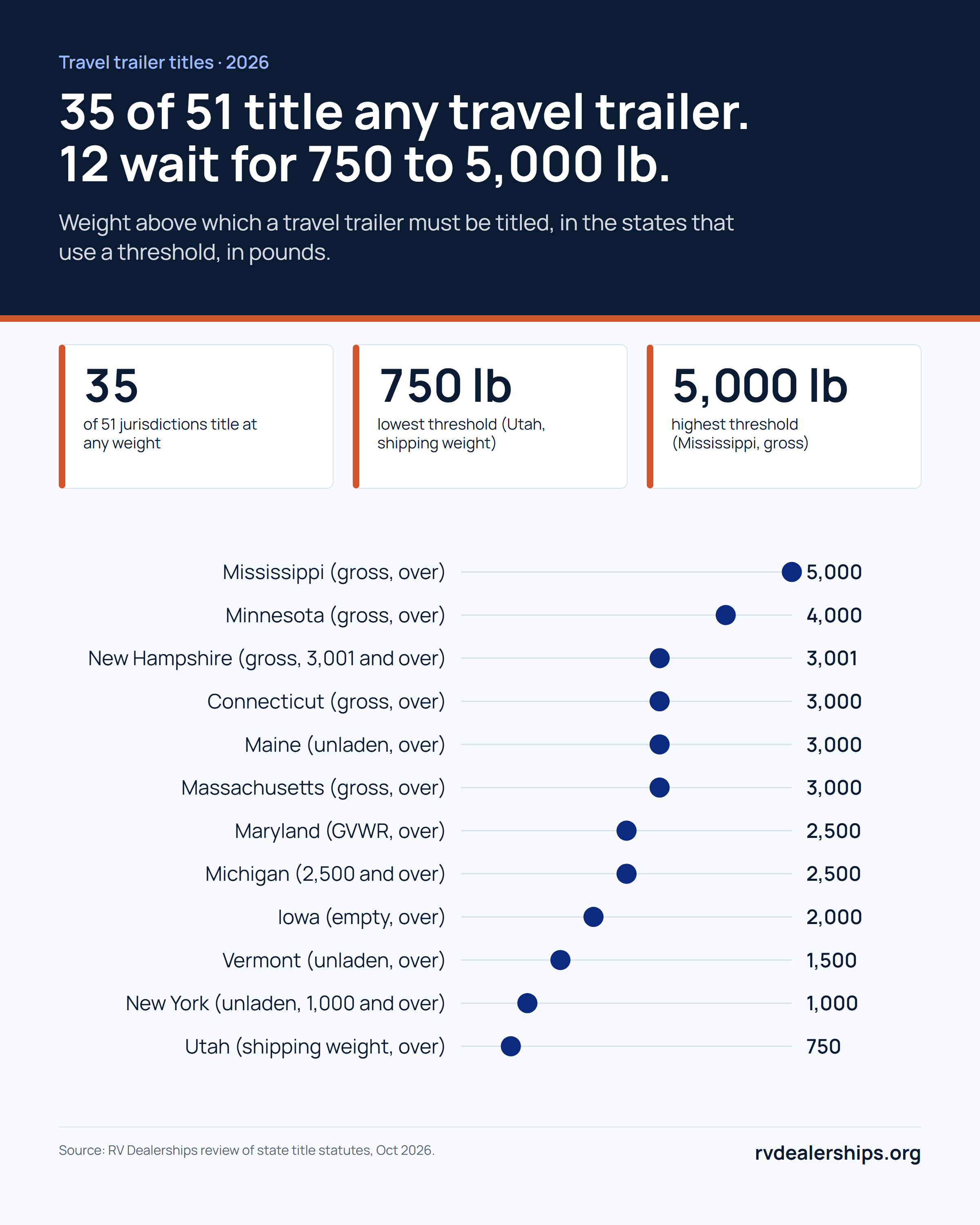
- Twelve states title only above a weight: Utah over 750 lb, New York at 1,000 lb, Vermont over 1,500 lb, Iowa over 2,000 lb, Maryland over 2,500 lb, Michigan at 2,500 lb, Connecticut, Maine and Massachusetts over 3,000 lb, New Hampshire at 3,001 lb, Minnesota over 4,000 lb and Mississippi over 5,000 lb.
- The weight basis differs: Iowa, Maine, New York and Vermont use unladen (empty) weight; Connecticut, Massachusetts, Minnesota, Mississippi and New Hampshire use gross weight, Maryland uses the manufacturer's GVWR, and Utah uses shipping weight. Check which one your trailer's paperwork lists.
- Three states turn on the type of trailer. Georgia titles 1986 and newer travel trailers but lists fifth wheels as not titled, Wisconsin exempts folding campers of 3,000 lb or less, and Tennessee requires no registration for pop-up and fold-down campers, which can get a title only on request.
- Hawaii issues no title for trailers at all. HRS 286-47.2 bars the county from issuing a certificate of ownership for a trailer or recording a lien on it; the signed registration certificate is what changes hands.
- Trailers need no odometer statement. Federal odometer rules exempt vehicles that are not self-propelled, but a motorhome sale needs one.
Title rules on the map
A title is the state's record of who owns the trailer and whether a lender has a lien on it. If a state doesn't title light trailers, the bill of sale and the registration become the proof of ownership, which makes a careful bill of sale more important.
Where weight decides
In the weight-threshold states, a small teardrop or pop-up can fall below the line while a full-size travel trailer is well above it. The threshold applies to the trailer, not the load, and states disagree on whether that means empty weight or gross weight.
The full table
| Alabama | Travel trailers and folding camping trailers up to 20 model years old, at any weight; utility trailers exempt | Not confirmed | Not confirmed | Ala. Dept. of Revenue title FAQ (Code 32-8-31) | |
| Alaska | All: every vehicle subject to registration must be titled; no trailer weight exemption | Required to drive, move or park on a highway (exceptions for areas off the road system) | Not confirmed | AS 28.10.201 and 28.10.011 | |
| Arizona | All: title required for every motor vehicle, trailer and semitrailer, within 15 days of purchase | Required to operate or leave a trailer standing on a highway | Not confirmed | A.R.S. 28-2051, 28-2153 | |
| Arkansas | All: Ark. Code 27-14-703 makes every trailer and semitrailer subject to the title and registration chapter, and its exceptions include no weight limit; 27-14-705 requires every owner to apply for registration and a certificate of title. DFA's travel trailer tax form tells buyers to submit the documents "to title and register the travel trailer" (statute read on Justia, unofficial copy) | Required: trailers pulled by cars and Class 1 trucks get a permanent AA trailer plate ($36); title fee $10 | Not confirmed | Ark. Code 27-14-703, 27-14-705 (Justia, unofficial copy), Ark. DFA form 10-384, DFA Trailer Tag Chart | |
| California | All: a certificate of ownership is issued whenever a trailer is registered | Required to drive, move or leave a trailer standing on a highway | Not confirmed | Cal. Veh. Code 4450, 4000 | |
| Colorado | All: the title law covers trailers and trailer coaches with no weight exemption, and plates are not issued until a Colorado title is issued or applied for | Required within 60 days of purchase for trailers used on highways, and for trailer coaches whether or not they are used on highways | Not confirmed | C.R.S. 42-6-102(10), 42-6-106 and 42-3-103 (CRS 2024 PDF, Colorado General Assembly) | |
| Connecticut | Over 3,000 lb gross weight | 3,000 | Not confirmed | Not confirmed | Conn. Gen. Stat. 14-166(a)(9) |
| Delaware | All: anyone who buys or otherwise acquires a new or used trailer must apply for a certificate of title; no weight exemption in the title subchapter | Not confirmed | A new vehicle bought from a dealer needs the dealer's bill of sale with the title application | 21 Del. C. 2302(d) and 2303 | |
| District of Columbia | All: no motor vehicle or trailer may be registered without a certificate of title, and a registered trailer may not be used on a public highway without one | Required for any trailer operated in DC | Not confirmed | D.C. Code 50-2201.03(d), 50-1501.02(a) | |
| Florida | All RV-type units, at any weight; other trailers from 2,000 lb net weight | Not confirmed | State form HSMV 82050 serves as notice of sale and bill of sale | Fla. Stat. 319.20 | |
| Georgia | 1986 and newer travel trailers and campers; fifth wheels and trailers of 2,000 lb or less are on the state's no-title list | Not confirmed | Not confirmed | Ga. DOR, Title Not Required or Optional, Motor Vehicle Online Manual | |
| Hawaii | None: the county may not issue a certificate of ownership (title) for any trailer or record liens on it; the registration certificate is the ownership record | Required; the county issues a trailer certificate of registration with endorsement lines for transfers | Seller and buyer sign the registration certificate; the buyer files it within 30 days, and a private seller notifies the county within 10 days | HRS 286-47.2, 286-52.5 | |
| Idaho | All, except utility trailers under 2,000 lb unladen | Not confirmed | Not confirmed | Idaho Code 49-501 | |
| Illinois | All: no trailer weight exemption in the title-exemption list | Not confirmed | Not confirmed | 625 ILCS 5/3-102 | |
| Indiana | All: a title is required for every vehicle that must be registered, and the registration exemptions include no travel trailers (among trailers, only disposable trailers) | Required to operate on a highway | Not confirmed | IC 9-17-2-1, 9-17-1-1, 9-18.1-2-2 and 9-18.1-2-3 (Indiana Code 2025, Title 9 PDF) | |
| Iowa | Over 2,000 lb empty weight; lighter trailers are exempt from titling | 2,000 | Required when moved on a highway; travel trailers pay 30 cents per square foot of floor space a year | Not confirmed | Iowa Code 321.123, 321.18 |
| Kansas | Travel trailers titled at any weight; boat trailers only over 2,000 lb | Not required for a travel trailer used as living quarters and not driven on highways | Not confirmed | K.S.A. 8-135 | |
| Kentucky | All: a resident owner must title a trailer within 15 days even if it is not used on highways; no weight exemption | Required, with insurance and a plate, before highway use | Not confirmed | KRS 186A.070, 186A.065, 186A.080 | |
| Louisiana | All: the title law covers every vehicle that must be registered, including trailers and semitrailers; a buyer must apply within 5 days of delivery | Required before a trailer or semitrailer is operated on a public highway | Not confirmed | La. R.S. 32:704, 32:707, 47:501 | |
| Maine | Over 3,000 lb unladen weight | 3,000 | Not confirmed | Not confirmed | 29-A M.R.S. 652(6) |
| Maryland | Over 2,500 lb GVWR; folding camping trailers (pop-ups) are titled at any weight | 2,500 | Not confirmed | Not confirmed | Md. Transp. 13-102(12), 11-106 |
| Massachusetts | Over 3,000 lb gross weight | 3,000 | Not confirmed | Not confirmed | M.G.L. c. 90D, 2(a)(9) |
| Michigan | Trailers 2,500 lb and over (the statute lists recreational vehicles separately; how it treats them is not confirmed) | 2,500 | Required when driven or moved on a highway | Not confirmed | MCL 257.216(1)(g) |
| Minnesota | Over 4,000 lb gross weight (or if a lender holds a lien or it was titled before) | 4,000 | Not confirmed | Not confirmed | Minn. Stat. 168A.03 |
| Mississippi | Only trailers over 5,000 lb gross vehicle weight must be titled (since 1999); lighter trailers may be titled voluntarily | 5,000 | Required: trailers register at the county Tax Collector as private trailers, with proof of ownership (bill of sale, MCO or title) | Not confirmed | Miss. DOR motor vehicle FAQs, Miss. DOR titles page |
| Missouri | All: a title is required before any trailer can be registered | Required | Not confirmed | RSMo 301.190 | |
| Montana | All: trailers and campers must be titled; the exemption covers mobile homes and housetrailers, and Montana defines travel trailers separately | Not confirmed | Not confirmed | MCA 61-3-201, 61-1-101 | |
| Nebraska | All, except farm and fertilizer trailers; utility trailer titles are optional | Not confirmed | Not confirmed | Neb. Rev. Stat. 60-137 | |
| Nevada | All: the DMV says trailers are titled in Nevada and are registered and titled in the same manner as motor vehicles; it states no weight exemption | Required to operate on a highway; the registration exemptions do not include travel trailers. Trailers under 1,000 lb get a small plate | Not confirmed | Nevada DMV, Vehicle Registration (June 2026 archived copy), NRS 482.205 and 482.210 | |
| New Hampshire | 3,001 lb gross weight and over | 3,001 | Not confirmed | Not confirmed | RSA 261:3 |
| New Jersey | All travel trailers; other trailers over 2,500 lb unladen | Required for all trailers; trailer registrations expire March 31 | Not confirmed | NJ MVC, Trailers | |
| New Mexico | All: every trailer driven or moved on a highway is subject to title; no weight exemption (exceptions are farm, government and similar uses) | Required when driven or moved on a highway | Not confirmed | NMSA 66-3-1 and 66-3-4 (NMOneSource, ch. 66 PDF) | |
| New York | 1,000 lb unladen weight and over; trailers made before the 1973 model year are exempt | 1,000 | Not confirmed | Not confirmed | N.Y. Veh. & Traf. Law 2102(a)(9)-(10) |
| North Carolina | All: the title-exemption list has no weight exemption for travel trailers | Required for highway use | Not confirmed | N.C.G.S. 20-50, 20-51 | |
| North Dakota | All: no trailer weight exclusion; housetrailers named in the definition | Not confirmed | Not confirmed | N.D.C.C. 39-05-01 to -02.2 | |
| Ohio | All recreational vehicles; other trailers over 4,000 lb | Not confirmed | Title application must be sworn before a notary public or other officer | ORC 4505.01, 4505.06 | |
| Oklahoma | Travel trailers: yes, at any weight. The title law's definition of vehicle leaves out other trailers except rental trailers | Not confirmed | Not confirmed | 47 O.S. 1102 and 1105 (complete Title 47, RTF) | |
| Oregon | All: no weight exemption; title is needed once the trailer is used on a highway or under an Oregon registration | Required: the light-trailer exemption does not cover travel trailers or campers | Not confirmed | ORS 803.030 | |
| Pennsylvania | All: the title-exemption list has no trailer exemption (tow dollies only) | Not confirmed | Not confirmed | 75 Pa.C.S. 1102 | |
| Rhode Island | Travel, fifth-wheel and park trailers always; cargo trailers over 3,000 lb GVWR | Not confirmed | Not confirmed | R.I. Gen. Laws 31-3.1-2 | |
| South Carolina | All: every vehicle that must be registered needs a title, and campers and travel trailers must be registered | Required: campers and travel trailers pay a $10 biennial fee and get a distinctive tag | Not confirmed | S.C. Code 56-19-220, 56-3-720 | |
| South Dakota | All: a trailer cannot be licensed until it is titled, and the only title exemptions are mopeds and certain farm vehicles | Title and license are obtained together at registration | Not confirmed | SDCL 32-3-4, 32-3-2.4 | |
| Tennessee | Travel trailers: yes. New trailers register on an MSO or title, and used trailers need a properly assigned title. Pop-up/fold-down, boat, utility and farm trailers need no registration and can get a title only | Required for all trailer types except farm, boat, utility and pop-up/fold-down trailers | Not confirmed | Tenn. Dept. of Revenue VTR-26, VT-10 | |
| Texas | Travel trailers always; other trailers over 4,000 lb GVW | Not confirmed | Not confirmed | Tex. Transp. Code 501.002(17) | |
| Utah | Over 750 lb shipping weight: trailers of 750 lb or less not used for hire are exempt from titling | 750 | Required for travel, camping and fifth-wheel trailers of 750 lb GVWR or more | Not confirmed | Utah Code 41-1a-501, 41-1a-504, 41-1a-202 |
| Vermont | Over 1,500 lb unladen weight; some long-held vehicles over 15 years old exempt | 1,500 | Not confirmed | Not confirmed | 23 V.S.A. 2012 |
| Virginia | All trailers | Required before highway use | Not confirmed | Va. Code 46.2-600 | |
| Washington | All: plates are not issued until a title is applied for, and the registration exemptions do not include travel trailers | Required to operate on a public highway | Not confirmed | RCW 46.12.520, 46.16A.030 | |
| West Virginia | All: trailers and recreational vehicles moved on a highway are subject to title; no weight exemption | Required for highway use | Not confirmed | W. Va. Code 17A-3-2 | |
| Wisconsin | Title follows registration. Folding camping trailers of 3,000 lb gross or less (not for hire) are exempt; the exemption does not name travel trailers or fifth wheels | Required on highways; exemption for trailers and camping trailers of 3,000 lb gross or less not used for hire | Not confirmed | Wis. Stat. 342.05, 341.05(13m), 340.01(48r) | |
| Wyoming | All: title required for any vehicle, trailers included; exemptions cover only federal, farm-implement and nonresident vehicles | Not confirmed | Not confirmed | W.S. 31-2-101, 31-2-102 and 31-1-101 |
"Not confirmed" means we could not verify that detail from an official statute or agency page; it does not mean no title or notarization is required. Download this table (CSV)
What a valid RV bill of sale should contain
There is no single national form. We compared two state DMV forms, Florida HSMV 82050 and California REG 135, with the federal odometer rule (49 CFR 580.5 and 580.17). A bill of sale that covers the following works as a starting point anywhere; use your state's own form when it has one.
- Seller and buyer: full printed names, addresses and signatures of every seller and buyer.
- The trailer or RV: year, make, model, body type and the full VIN (or serial number), plus the title number if one exists.
- The deal: date of sale and selling price. If it is a gift, say so; California's form asks for the relationship and gift value.
- Odometer statement for motorhomes: federal law requires a mileage disclosure on the title for self-propelled vehicles. It does not apply to trailers (not self-propelled) or to vehicles over 16,000 lb GVWR, and model year 2011 and newer vehicles stay subject to it for 20 years.
- A certification: both state forms we read use a signed statement under penalty of perjury that the information is true.
- Notary, where the state requires it: Ohio requires the title application to be sworn before a notary. Ask your DMV before you meet the buyer.
- Keep a copy. Florida's form notes that ownership does not change until the buyer is issued a title, so a seller should file any notice of sale the state offers.
What it means for you
- Buying a used trailer without a title? In an all-weights state that is a red flag: the seller should have one. In a threshold state, confirm the trailer's weight from the VIN sticker before you accept a bill of sale alone. In Hawaii there is no trailer title; the signed registration certificate transfers ownership.
- Get the VIN right. Copy it from the frame or sticker, not from an old registration, and make sure it matches every document.
- Check for liens. A title shows the lienholder. Without one, ask the seller for proof the trailer is paid off.
- Dealer sales are simpler. A dealer handles title and registration paperwork, usually for a doc fee; see RV dealer doc fees by state. Browse travel trailer dealers, teardrop trailer dealers and pop-up camper dealers.
- Selling? Keep a signed copy of the bill of sale and file any notice of sale your state offers so later tickets or tolls are not yours.
Budget for the tax due at registration with RV sales tax by state, and check Sunday sales rules if you plan to buy on a weekend.
The infographic
Free to use with a link. Publish the graphic or the numbers anywhere, as long as you credit RV Dealerships with a link to this page.
How we did this
- We read state title statutes on Oct. 24 and 25, 2026, focusing on the list of vehicles exempt from titling and on how each state defines trailers and recreational vehicles. Where we could not read the statute, we used the state DMV or revenue department's own published rules (Alabama, Georgia, Mississippi, New Jersey and Tennessee). For Colorado we read the General Assembly's CRS 2024 Title 42 PDF, for Indiana the Indiana Code 2025 Title 9 PDF, and for Nevada the DMV's vehicle registration page (an archived June 2026 copy, because the live page returned an error) alongside NRS 482. For New Mexico we read the Compilation Commission's official chapter 66 PDF, and for Oklahoma the Legislature's complete Title 47 file. Each verified row links to the source we read.
- "Title required at any weight" means the law has no weight exemption that reaches travel trailers, even if lighter cargo or utility trailers are exempt; Alabama limits titling to trailers up to 20 model years old and New York exempts pre-1973 models. "Above a weight threshold" means a travel trailer under the stated weight needs no title. "No title issued" covers Hawaii, where the statute bars titling trailers. "Depends on trailer type" covers Georgia, where fifth wheels are on the no-title list, Wisconsin, where the light-trailer exemption names folding campers but not travel trailers, and Tennessee, where the Department of Revenue exempts pop-up and fold-down trailers from registration and lists title-only for trailers that need no registration.
- On October 25, 2026 we closed the last three open rows from agency pages: the Mississippi Department of Revenue's motor vehicle FAQs and titles page (trailers over 5,000 lb GVW must be titled), the Tennessee Department of Revenue's help-center articles VTR-26 and VT-10, and two Arkansas DFA documents (travel trailer tax form 10-384 and the Trailer Tag Chart). Those DFA documents show that travel trailers are titled but not whether any weight exemption applies, so we then read Arkansas Code title 27, chapter 14 on Justia's 2025 copy (unofficial; the official code is published only through LexisNexis). Section 27-14-703 makes every trailer and semitrailer subject to the chapter, with exceptions only for dealer and transit moves, highway crossings, farm implements, special mobile equipment, trolley vehicles, cancelled mobile home titles and federal vehicles, and 27-14-705 requires a title application for every vehicle subject to registration. The 6,000 lb figure in the Permanent Trailer Licensing Act (27-14-1202) decides which trailers get a permanent plate, not which are titled. Arkansas is therefore counted as titling travel trailers at any weight, and no state is left unclassified. Notary details are shown only where the source we read states them; where a cell says "Not confirmed" we did not verify it.
- Several rows, including Montana, South Carolina, Washington and Wisconsin, rest on how a state's title, registration and definition sections fit together, as quoted in the row. Ask the state DMV before relying on a borderline case such as a very light teardrop or pop-up.
- The bill-of-sale list is drawn from Florida form HSMV 82050, California form REG 135 and the federal odometer disclosure rule (49 CFR 580.5 and 580.17). It is a general checklist, not a substitute for a state's required form. This page is general information, not legal advice.
Not legal advice. Laws and agency rules change. Each row links the source we read and the date we checked it; confirm with the agency or an attorney before you rely on it.
Sources
- Florida Statutes 319.20, accessed October 25, 2026
- 625 ILCS 5/3-102, accessed October 25, 2026
- 75 Pa.C.S. 1102, accessed October 25, 2026
- Minnesota Statutes 168A.03, accessed October 25, 2026
- Massachusetts General Laws c. 90D, 2, accessed October 25, 2026
- Michigan Compiled Laws 257.216, accessed October 25, 2026
- Texas Transportation Code 501.002, accessed October 25, 2026
- Ohio Revised Code 4505.01 and 4505.06, accessed October 25, 2026
- Alaska Statutes 28.10.201, accessed October 25, 2026
- Arizona Revised Statutes 28-2051, accessed October 25, 2026
- California Vehicle Code 4450, accessed October 25, 2026
- Connecticut General Statutes 14-166, accessed October 25, 2026
- Georgia DOR, Title Not Required or Optional, accessed October 25, 2026
- Iowa Code 321.123, accessed October 25, 2026
- Kentucky Revised Statutes 186A.070, accessed October 25, 2026
- Maryland Transportation 13-102, accessed October 25, 2026
- New Jersey MVC, Trailers, accessed October 25, 2026
- New York Vehicle and Traffic Law 2102, accessed October 25, 2026
- Oregon Revised Statutes 803.030, accessed October 25, 2026
- Wisconsin Statutes 342.05 and 341.05, accessed October 25, 2026
- 49 CFR 580.5, Disclosure of odometer information, accessed October 25, 2026
- 49 CFR 580.17, Exemptions, accessed October 25, 2026
- Florida HSMV 82050, Notice of Sale and/or Bill of Sale, accessed October 25, 2026
- California DMV REG 135, Bill of Sale, accessed October 25, 2026
- New Mexico Statutes 66-3-1 and 66-3-4 (NMOneSource, ch. 66), accessed October 25, 2026
- Oklahoma Statutes Title 47, 1102 and 1105 (complete title), accessed October 25, 2026
- Delaware Code Title 21, 2302 and 2303, accessed October 25, 2026
- Colorado Revised Statutes 2024, Title 42 (42-6-102, 42-6-106, 42-3-103), accessed October 25, 2026
- Hawaii Revised Statutes 286-47.2, accessed October 25, 2026
- Hawaii Revised Statutes 286-52.5, accessed October 25, 2026
- Indiana Code 2025, Title 9 (IC 9-17-2-1, 9-18.1-2-2), accessed October 25, 2026
- Louisiana R.S. 32:707, accessed October 25, 2026
- Louisiana R.S. 32:704, accessed October 25, 2026
- Louisiana R.S. 47:501, accessed October 25, 2026
- Nevada DMV, Vehicle Registration (archived copy), accessed October 25, 2026. The live page, dmv.nv.gov/nvreg.htm, returned 404 on 2026-10-25
- Nevada Revised Statutes chapter 482 (482.205, 482.210), accessed October 25, 2026
- Utah Code 41-1a-504, accessed October 25, 2026
- D.C. Code 50-2201.03, accessed October 25, 2026
- D.C. Code 50-1501.02, accessed October 25, 2026
- Ark. Code 27-14-701 to 27-14-728, Registration and Certificates of Title (Justia, unofficial copy), accessed October 25, 2026. Official code is published only through LexisNexis.
- Ark. Code 27-14-1201 to 27-14-1218, Permanent Trailer Licensing Act of 1979 (Justia, unofficial copy), accessed October 25, 2026
- Arkansas DFA form 10-384, travel trailer local tax credit, accessed October 25, 2026
- Arkansas DFA Trailer Tag Chart (fee schedule part 3), accessed October 25, 2026
- Mississippi DOR motor vehicle FAQs, accessed October 25, 2026
- Mississippi DOR motor vehicle titles, accessed October 25, 2026
- Tennessee Department of Revenue VTR-26, Trailer Title and Registration, accessed October 25, 2026
- Tennessee Department of Revenue VT-10, Title Only Examples, accessed October 25, 2026
Cite this: RV Dealerships, "Travel trailer title rules by state: 35 of 51 jurisdictions title them at any weight, 12 only above 750 to 5,000 lb," October 25, 2026, https://rvdealerships.org/travel-trailer-title-requirements-by-state/
Spotted an error or have newer data? Tell us and we'll check it and update the page.
Questions people ask
Do travel trailers need a title?
In most places we verified, yes. 35 of 51 jurisdictions (50 states and DC) title travel trailers at any weight, including Arkansas, California, Colorado, Illinois and Texas. Twelve title them only above a weight, from more than 750 lb in Utah to more than 5,000 lb gross in Mississippi. Georgia lists fifth wheels as not titled, and Hawaii issues no trailer titles.
At what weight does a trailer need a title?
It varies. Utah titles above 750 lb shipping weight, New York from 1,000 lb unladen, Vermont above 1,500 lb unladen, Iowa above 2,000 lb empty, Maryland above 2,500 lb GVWR, Michigan from 2,500 lb, Connecticut and Massachusetts above 3,000 lb gross, Maine above 3,000 lb unladen, New Hampshire from 3,001 lb, Minnesota above 4,000 lb and Mississippi above 5,000 lb gross. Florida, New Jersey, Ohio and Texas title every travel trailer.
Does a travel trailer bill of sale need an odometer reading?
No. Federal rules exempt vehicles that are not self-propelled from odometer disclosure, so a trailer sale needs none. A motorhome does need one unless it is over 16,000 lb GVWR or old enough to be exempt; model year 2011 and newer vehicles stay covered for 20 years.
What should an RV bill of sale include?
Names, addresses and signatures of buyer and seller, the year, make, model and full VIN, the date and price, the title number if there is one, an odometer statement for a motorhome, and a signed certification that the facts are true. Use your state's DMV form if it has one.