RV PDI checklist for the walk-through before you sign
By Corinne Batey · October 21, 2026
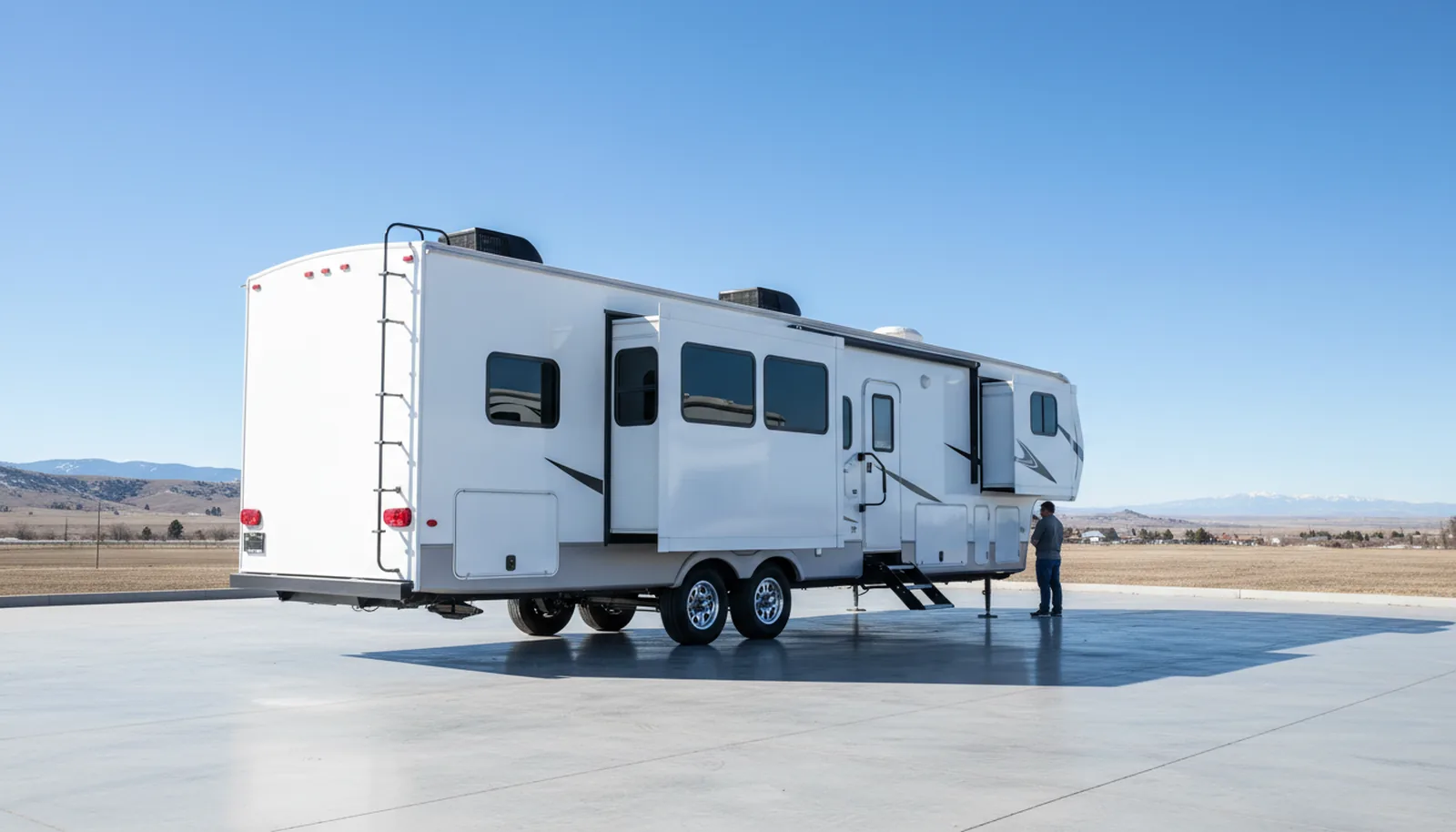
The July I picked up my fifth wheel, new, from a dealer just off I-25, I’d been shopping travel trailer and fifth wheel dealers in Denver for months. The one I picked swore its prep was done. It wasn’t. I got on my knees in the basement, ran my hand along a water line, and found a loose fitting dripping into the insulation. Ten minutes with a wrench. But only because I looked. My RV PDI checklist exists because dealers miss things, I miss things, and a wet basement six states later costs real money. That’s why I made it.
What an RV PDI checklist is and who does what
PDI means pre-delivery inspection, and the only part that protects you is the walk-through you do yourself. The dealer’s tech goes through the rig before you show up. They usually sign a form saying everything is ready. That form is their promise, not your proof.
The walk-through is your turn. A service or delivery person shows you every system, and you run it yourself. Plan three or four hours. Bring a notepad, a flashlight, a phone charger for filming, and ask if they’ll put a ladder up so you can see the roof.
Ask before you show up whether the unit can be on shore power, with propane and water connected. In winter, ask if they’ll de-winterize it. Some dealers will also let you stay a night on site, wich beats finding a leak at your first campground.
Exterior and roof: start at the top
Look at the roof first (from the ladder, if the dealer lets you), because that’s where the bill that never goes away gets in. Check the sealant around every vent, skylight, antenna, and the AC. Cracked or peeling sealant is the begining of water damage.
Run your hand along the sides at eye level and look for delamination. On fiberglass, waves or bubbles in the skin mean the lamination failed, usualy from water. Walk the whole rig. Check the awning for tears and make sure it extends and retracts smoothly.
Check the tires. The four-digit DOT date code shows the week and year. Tires older than five to seven years often need replacing no matter the tread. So if you’re buying new, the code should be recent. Check pressure and look for cracks. Check the lights, turn signals, and brakes one by one with a helper.
Hitch, brakes, and breakaway
The hitch or pin box has to match your truck, or you don’t leave the lot. I once saw a dealer try to send a fifth wheel home with the wrong jaw size in the hitch. Check your truck’s ratings on the driver’s door jamb against the trailer’s weights, not the salesman’s opinion.
Test the breakaway switch. Pull the pin and have somebody ease the truck forward at a crawl. The trailer brakes should lock up. If they don’t, the breakaway battery or wiring is bad. Put the pin back right away, because it drains the battery.
My printable RV PDI checklist
- Roof sealant around every opening, no cracks or gaps
- Sidewalls and caps, no delamination or waves
- Tires: DOT date codes recent, no cracks, correct pressure
- All lights, brakes, and turn signals work
- Breakaway switch pulls and brakes engage
- Hitch or pin box matches tow vehicle and is tight
- Slides extend and retract with no grinding or hesitation
- Awning opens and closes fully
- Leveling jacks (if equipped) operate and auto-level without errors
- Water system: pump on, every faucet runs, no drips under sinks or in basement
- Water heater works on propane and electric
- Furnace lights and blows warm air
- AC cools on high and low
- Refrigerator runs on both modes (check back in a few hours)
- Microwave, outlets, and all 120-volt items work on shore power
- Generator (if equipped) starts, runs under load, and hour meter noted
- Smoke, CO, and LP detectors test and have future expiry dates
- House batteries are charged and hold voltage
- Every key, remote and manual is accounted for
- Any issue is on a signed we-owe slip before you take delivery
I found this walkthrough video helpful for seeing the pickup day process in action.
Water system: run it, then look underneath
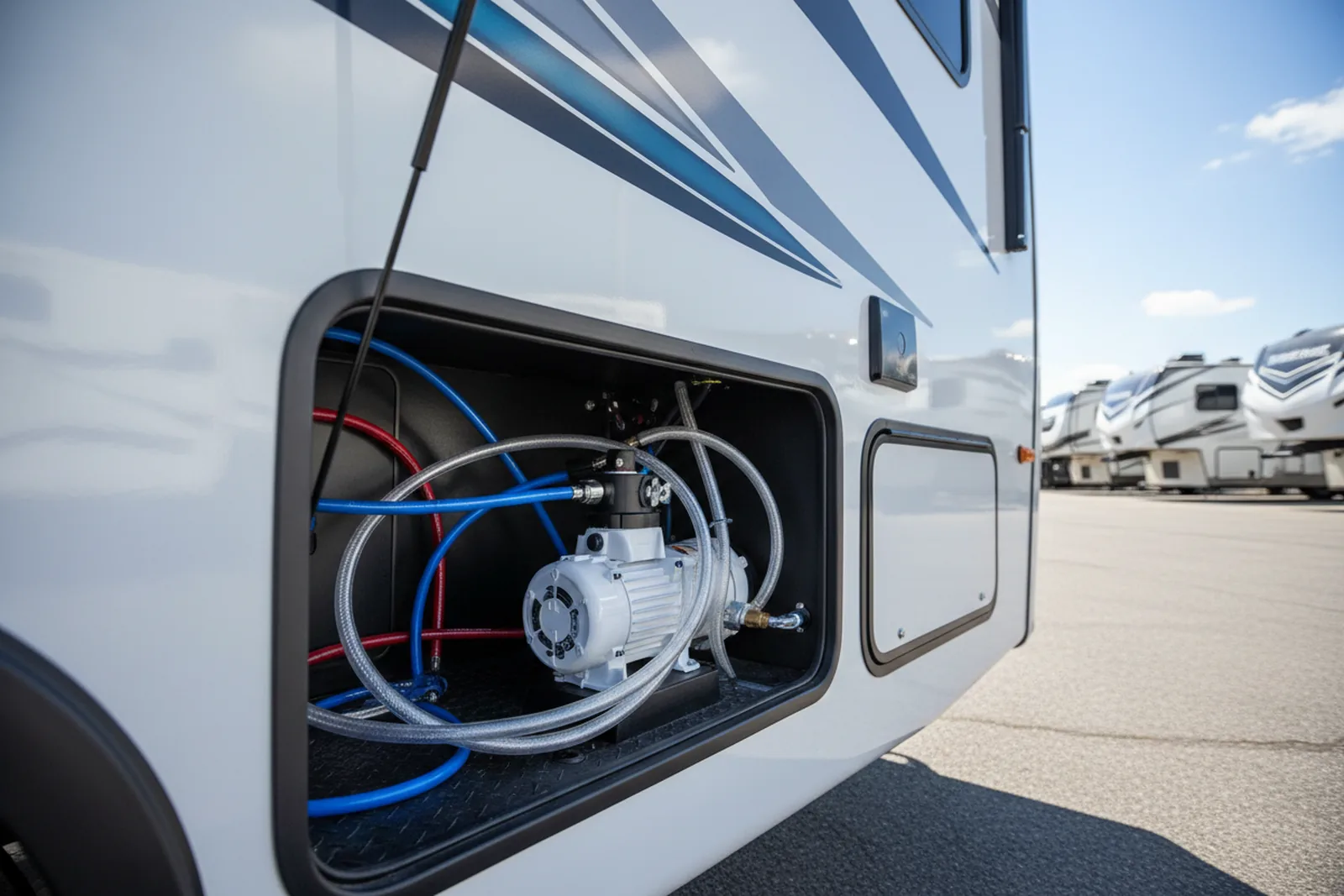
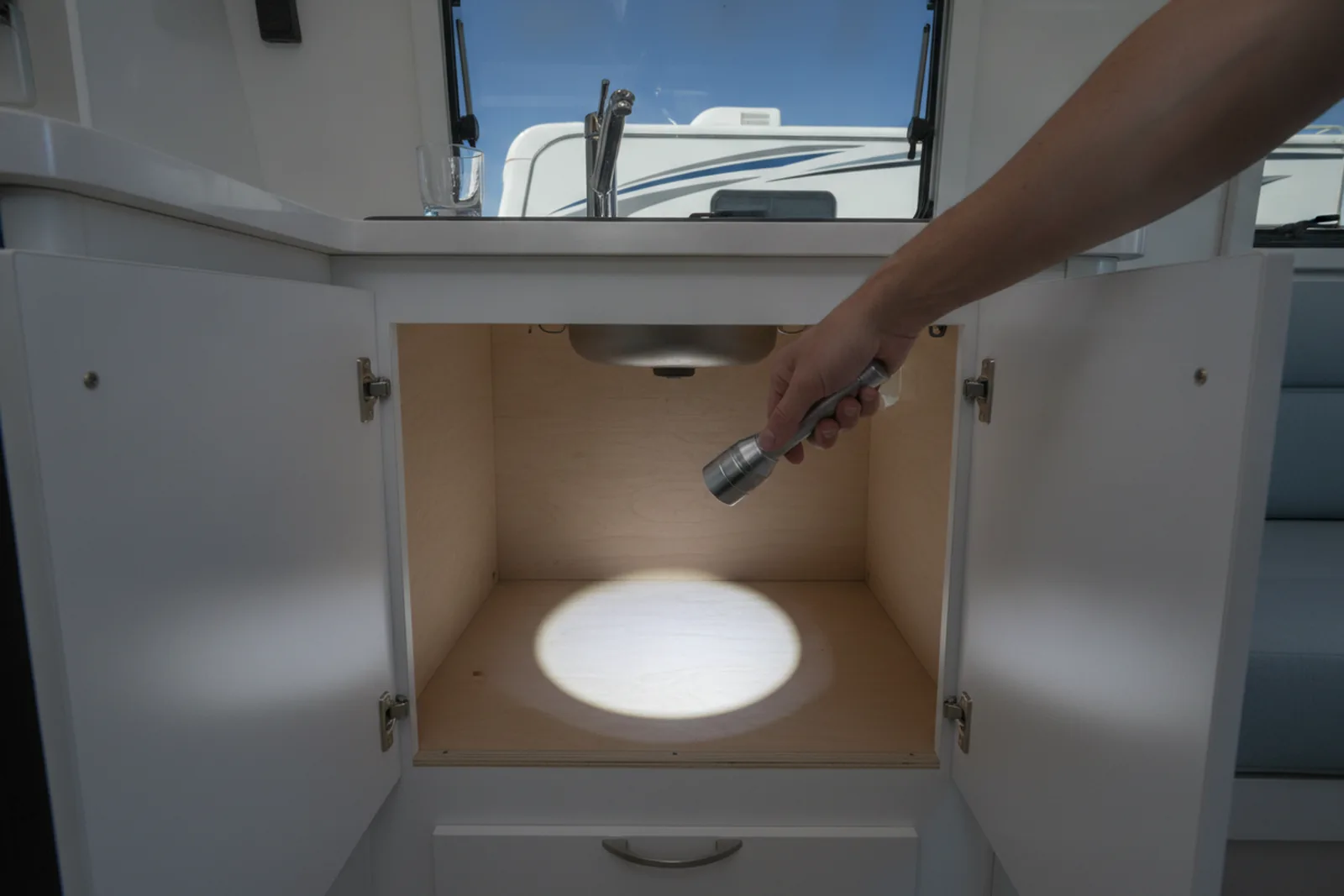
Hook up city water or fill the tank and turn the pump on, then use your hands more than your eyes. Run every faucet, the toilet, the outside shower. Then get on the floor. Look under every sink, behind the water heater, and into the basement storage. Use your hands. A drip you feel now is a cabinet you replace later.
Test the water heater on propane and electric, with the tank full and the bypass closed. On electric it takes time, and the element can be dead even if propane works. Check the black and gray tank valves. Dump them if you can, or have the dealer show you.
That’s where my Denver drip showed up: a brass fitting barely finger tight. The tech’s checklist said water system tested. My hand said otherwise.
Appliances and electrical: the boring stuff that strands you
The refrigerator is the slowest test, so start it first and check it last. On a new rig, run it on electric while you do everything else, then switch to propane for a few minutes and listen for the burner. Absorption fridges take hours to cool, so plan to come back or ask about a night on site.
Turn the furnace on even in July. I bought my old travel trailer in the desert and never touched the furnace untill a 20-degree night in Montana. The sail switch was bad. Three days later I had a $300 bill from a mobile tech and a freezing husband.
Test the AC on high and low. Check every outlet with a night light or a cheap tester. Microwave a cup of water. If it has a generator, start it and run a heavy load like the AC for fifteen minutes while watching the hour meter.
Detectors, batteries, and the final paperwork
Press the test button on the smoke, CO, and propane detectors before you sign anything, because a dead detector is a paperwork problem as much as a safety one. Look for an expiration date. On a new rig they should be fresh. On a used one, ask for anything expired to be replaced before delivery.
Check the house batteries. On a towable, they may be cheap dealer batteries. Ask what came from the factory and what the dealer added. A multimeter is the best tool; a lead-acid battery at rest reads about 12.6 volts full. Ask for the batteries to be load tested.
Walk through every key, remote, and manual. Open the outside shower, the outside kitchen if you have one, and every cabinet. Write a punch list. Get anything not fixed on a signed we-owe slip before you sign delivery acceptance, that slip is the only paper trail between “we’ll take care of it” and a repair bay that’s booked for six weeks.
Should you hire an independent inspector?
Ive bought four RVs and never hired one. I got lucky once and found my own problems the other times. But Ive also crawled on my back under a fifth wheel at 9 p.m. In a dealer’s storage lot. A certified inspector from the National RV Inspectors Association costs a few hundred to over a thousand dollars, and they see things I don’t.
For a used rig, read our post on what to look for when buying a used RV on a dealer lot, and consider the inspector a cheap insurance policy. Dealers may push back on outside inspectors, but ask before you commit.
A thorough PDI doesn’t change your warranty. It just gets problems on paper while the dealer still wants you happy, before they turn into warranty arguments. The travel trailer and fifth wheel dealers nationwide directory can help you compare delivery prep reputations before you sign anything.
The mistake I’d make again
I’d rather annoy a dealer with a slow walk-through than discover the furnace on a mountain pass. The Denver drip taught me that a PDI form is a starting point, not a report.
This weekend, call two dealers near you and ask each one to email you a written out-the-door quote on the same new or used unit. While you’re on the phone, ask if they allow independent inspectors on the lot and whether you can do a full water and generator test at delivery. The way they answer tells you more than the glossy brochure does.
And four hours of my time on a concrete pad beats three nights in a hotel waiting for a mobile tech.
More from the lot
FAQ
How long does an RV PDI take?
Plan three to four hours for a thorough walk-through. A fifth wheel or motorhome with slides, leveling, and a generator takes longer than a small travel trailer. Rushing means you sign for problems you haven't found yet.
What does PDI mean on an RV?
PDI stands for pre-delivery inspection. The dealer's technician goes through the unit and fixes what they find before you arrive. Your walk-through is seperate, and it's where you verify their work.
Can I sleep in the RV at the dealership before I buy it?
Some dealers allow a night on site or at a nearby campground before final delivery. Always ask. It's the best way to test the furnace, water heater, and bed comfort without rushing.
What should I do if I find problems during the walk-through?
Write them down and get a signed we-owe slip before you sign the delivery acceptance. The slip should list each item and the expected fix. Verbal promises don't hold up when the service department is busy.
Is a dealer prep fee the same as a PDI?
Not exactly. The prep fee is what the dealer charges for getting the unit ready, and the PDI is part of that work. Some dealers list them separately, some roll them together. Ask for an itemized breakdown.
Do RV extended warranties cover PDI issues?
Usually that's not what they're for. Problems you find at delivery on a new unit belong to the dealer and the manufacturer's warranty, so get them on the we-owe slip. A service contract covers listed failures later, and many exclude problems that were there before it started. Read our post on [RV extended warranty cost and coverage](/blog/rv-extended-warranty-cost/) to understand what a service contract actually covers.
Find RV dealers near you
Compare new and used RV dealerships in your city, then ask a few what they have in stock.
Browse by stateOr jump to: Fort Worth, TX · Lake Havasu City, AZ · Longmont, CO